A Five-Minute Debrief for the End of a Group Project
A five-minute debrief for a group project helps your team capture what worked, what caused friction and one useful observation for its next task.
What can your team learn after a project without turning the last meeting into another planning session? A five-minute debrief for a group project can capture one useful choice, one point of friction and one observation to revisit next time.
Treat five minutes as a target, not a strict limit. The routine works best with a small group, a finished deliverable and brief turns; a larger team or a sensitive issue may need more time or a separate conversation. Open a shared note, set a timer and keep the discussion focused on how the team worked.
Use five minutes as a flexible target
Before starting, confirm that the project is finished for now. Put outstanding tasks in the project’s normal tracker, such as Trello, Asana or a shared team document, with an owner and next action. Do not let the debrief quietly become a status meeting.
For a small group, use this timing as a guide:
- Opening: State that the deliverable is closed and explain the three prompts.
- Useful choice: Give each person a brief turn to name one decision or action that helped.
- Friction: Ask where the work became harder than necessary.
- Carry forward: Choose one observation to bring to the next project.
- Close: Read the note back and say where it will be saved.
If the group cannot give everyone a fair turn within the target, ask for short written responses or book a longer session. Do not rush a difficult or personal concern to preserve the timer.
Ask for specific observations, not verdicts
Use three prompts: “What choice helped us?”, “Where did the work become harder?” and “What should we remember next time?” Ask for a moment or process rather than a broad judgement such as “communication was good”.
Keep friction about the work, not a person’s character. “We were unsure who could approve the final copy” identifies a process problem. “Alex held things up” assigns blame and gives the team less to improve. If a comment turns personal, ask which expectation, hand-off or decision made the work difficult.
Let anyone pass. If people prefer to think before speaking, ask them to write a phrase in a shared document or the team’s usual channel. Make clear whether names will be attached, and do not describe a note as anonymous if its author is visible.
Record the three points in a shared note
Use a meeting note, Google Docs file, Microsoft Teams channel or the project folder your group already checks. Add these headings:
- Useful choice: Name the action and what it helped the team do.
- Friction: Describe the moment or process that caused difficulty.
- Carry forward: Write one observation the next team can consider.
Keep each entry to a sentence. Separate an observation from a proposed fix: “The reviewer received the draft after the layout was set” describes what happened; “send it earlier” is a possible response. The team can record the suggestion without adopting it as a rule.
Before closing, read the entries aloud or paste them into the call chat. Ask the people who raised them whether the wording is accurate. If views differ, preserve the difference instead of editing it into false agreement.
How should you adapt the debrief?
What if the project is not finished?
Move the debrief until the main work is closed. If a task remains, record its owner and next action in the project tracker first, so reflection does not get tangled with delivery planning.
What if the team is too large for a spoken round?
Ask everyone to add one short response under each prompt in a shared note, then read a few aloud. If the group still cannot review the points fairly in the available time, schedule a longer session.
What if people disagree about the cause?
Write down the distinct observations without forcing a single explanation. If the disagreement involves a sensitive issue or needs more context, arrange a separate conversation with the relevant people.
Where should the debrief note go?
Save it in the project folder or team channel people already use, then link it from the next project’s opening notes. Bring the carry-forward point into discussion as a prompt, not a rule that must fit every team.
Work through a short debrief with a concrete example
Say a team has just handed over a shared presentation. Its starting inputs are three people, a finished slide deck, a team channel and a five-minute target. One person recalls that collecting comments before the final review helped; another says the team did not know who could approve changes. A third prefers to pass.
- Confirm closure: The deck has been handed over, so the team leaves any remaining follow-up in its project tracker rather than reopening the work.
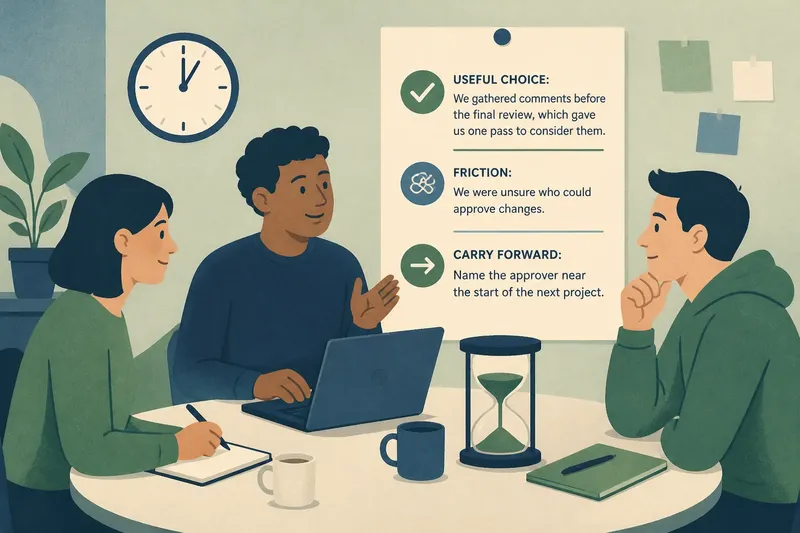
- Collect the useful choice: The team records, “We gathered comments before the final review, which gave us one pass to consider them.”
- Describe the friction: It writes, “We were unsure who could approve changes.” It does not name or blame an individual.
- Choose what to carry forward: The team records, “Name the approver near the start of the next project.” This is a prompt for the next kickoff, not a promise that approvals will never be delayed.
- Check and save: The team reads the note back, confirms that the wording reflects the two contributions, and posts it in the team channel for the next project’s opening discussion.
The third person’s pass is respected, and the note still captures a useful choice, a process problem and a possible next-project prompt. If discussion of approval becomes personal or needs more time, the team stops the debrief and arranges a separate conversation.
A five-minute debrief for a group project is useful when it leaves the next team with a clear question to consider, not a list of rules. Put the note where the next project begins, so its observations can inform a fresh decision.